Myfriend, Rohan Rodrigo, brought a knuckleduster to the classroom.
Rohan is a tough, brave boy, bringing in a hand-to-hand weapon, everybody thought.
Whom is he going to use it against? was on everyone’s mind. Rohan was the fearless hero of the day with a weapon. Brandishing it, he was showing it off to fellow classmates. The boys gathered around him, marvelling at this weapon, touching and admiring it.
D J Antony, our language teacher, walked into the class — pin-drop silence, not because of fear, but because every student respected D J Antony. From the corner of his eyes, D J Antony saw Rohan trying to conceal his knuckleduster, hiding it among his schoolbooks.
D J Antony did not utter a word. He pretended everything was normal. Quietly, he came to Rohan’s desk and took the knuckleduster away. There was no drama. His friends around him expected the worst. But D J Antony was calm. Back at his desk, D J Antony packed the knuckleduster in his bag and continued the class as if nothing happened. His timely action prevented a likely weaponised teenage brawl.
That act was not unusual for D J Antony, this liberal teacher at St. Benedict’s College in Colombo, our high school in grade ten. The teenage boys never took kindly to the other teachers but not to D J Antony. They loved D J Antony, adoring and listening to him in his class. Everyone waited for his period when he taught Sinhala, the native majoritarian language in Sri Lanka. Not only taught the language, but he also taught them psychology about growing pains. In an age where sex education was a foreign concept in schools, D J Antony knew the art of explaining this difficult subject to the boys as tactfully as he could.
The teachers had strange nicknames, from ‘Japanese cat’ to ‘Coconut oil’. Nobody was spared of this humorous name-calling. Not even D J Antony. He had a nickname, but it was said with a tang of gentleness. His was ‘Nas polla’, simply translated as ‘nose rod’. He had a rustic, deep voice, so the name. Do not ask me how people come up with these weird nicknames; that was an art of their own, only known to Sri Lankan islanders. D J Anthony was a strong, well-built and alpha male. That, coupled with his rustic voice, ‘Nas Polla’ became his idolised name among the boys. He was the Jamie Fox of our generation.
D J Antony, our beloved teacher, was always on time for class. He took his profession seriously, wearing clean white pants and a shirt. He was different. He was young as a teacher in his twenties, relating well to the teenage boys under his wing. He was passionate about teaching and his life mission.
Teaching and giving back to his community was his calling from his student days at St Benedict’s, the same school where D J Antony studied ten years earlier. To achieve his career goal, he went to university and then teachers formation school, studying child psychology. Then he returned to his old school as a teacher. He was very proud of his job, educating and empowering youth.
Every boy loved D J Antony’s wisdom. There was a soft corner for him in every boy’s heart.
I loved being a student in his class.
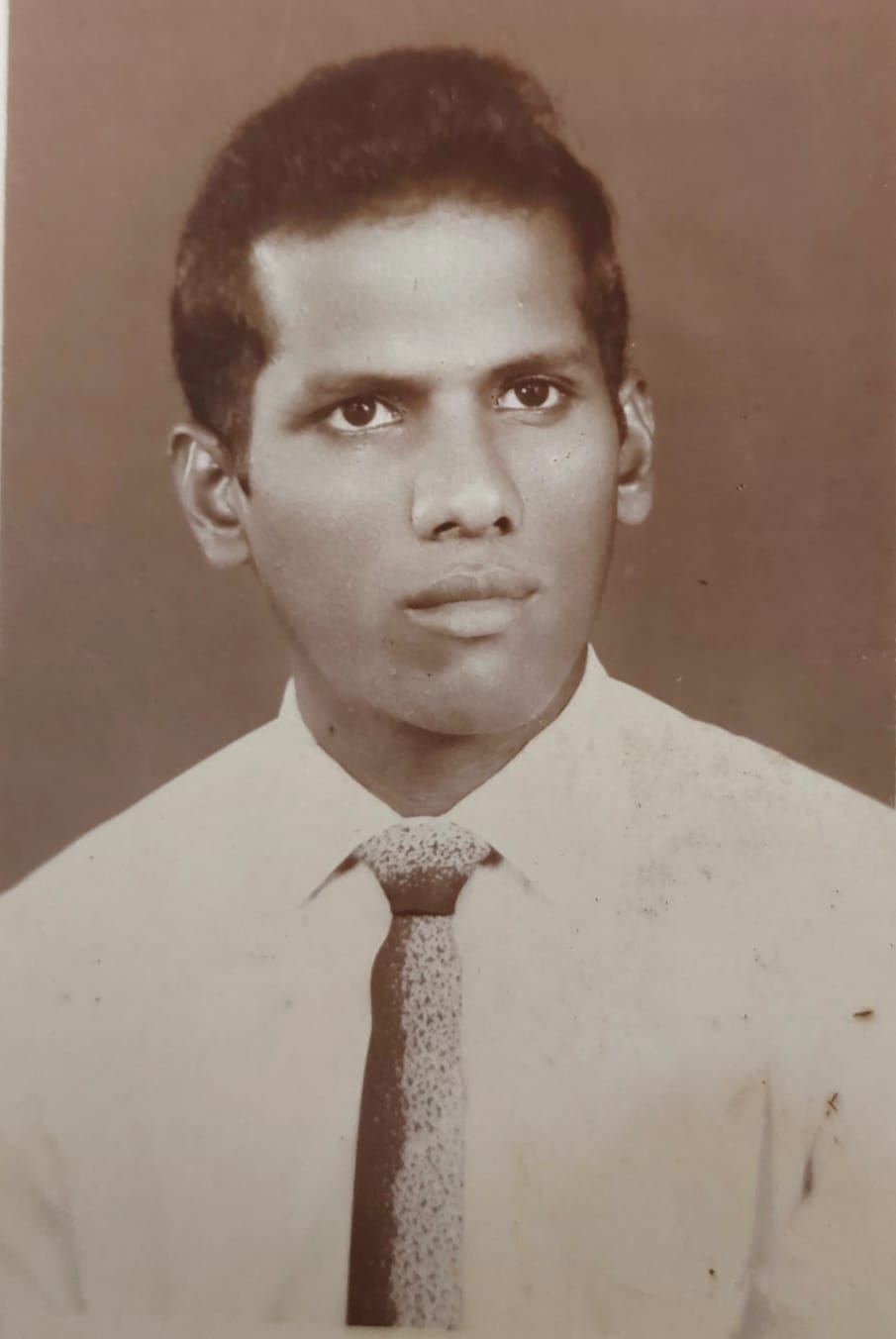
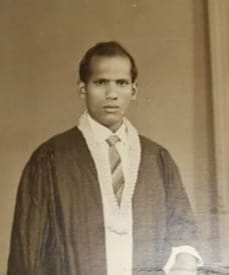
D J Antony as a young teacher and, at his graduation, a redeemer of youth
Now, this is the thing. D J Antony was also my relative. His mother was related to my parents. D J Antony’s mother, lovingly called Julie Akka, lived with my grandparents when my mother was a young girl. Julie looked after my mother as a toddler. Our relationship was entrenched going back a few generations. D J Antony’s mum was my grandmother’s cousin. As a young boy, we visited his family home whenever we attended mass at the church in Pamunuwila, the neighbouring suburb where D J Antony lived. D J Antony had seen me grow up.
But in school, I was just another boy in his class. There was no preferential treatment. No nepotism. Neither one of us expected any. But I was conscious that I had to do my best in his presence. He was my teacher, and I was his student. That’s all. The family relationship was put aside in school. Simple and professional in a country saddled with family nepotisms in social and political life, almost every aspect of life.
Nobody in school knew our family relationship. It was not relevant to my student-teacher relationship.
That year the school organised an educational day trip for year ten boys. D J Antony was the teacher leading the trip to the ancient rock Sigiriya and Dambulla cave temples in north-central Sri Lanka.
Wearing my long pants and excited, I joined my school friends on the trip. I was the first boy on the bus, cause the touring bus started from D J Antony’s home, not far from mine. A bus full of boys joined, singing and enjoying ourselves. We started early and enjoyed this day trip under D J Antony’s caring supervision. We climbed Sigiriya Rock and toured other historic sites. D J Antony had a time keeping the testosterone-pumped high-energy boys in check, but he was good at it.
I was experimenting with smoking as every teenager did back in the day. During a break in the trip, I felt bold. I lit a cigarette and showed off to my friends, pretending to be a grown-up.
Lo and behold, D J Antony saw me in the act. That was not expected. I shivered in my pants. Not only was he my teacher, but he was also my uncle. I panicked, imagining what would happen to me if my mother came to know about my delinquency. I was in double jeopardy.
But the graceful D J Antony just gave me one look. I was conscious of my misadventure, sweating and nervously imagining how my mother would react.
To my luck, D J Antony simply ignored the incident. He never mentioned the episode to my parents. Whenever he visited our home, I was conscious of what I had done, smoking and getting caught. That embarrassing moment never came to pass, thanks to D J Antony.
I was grateful for his gracious and thought-leading act — discipline and corrections with love and without a fuss.
D J Antony knew his boys, had the foresight to understand growing youngsters, and nurtured them when education was yet to evolve in Sri Lanka — the best child psychologist of a teacher for teenage boys back in the day. I am sure many generations after me benefitted from his foresight: lovely man, an educator with emotional intelligence on the tiny island of Sri Lanka.
That’s why I think fondly of D J Antony. Not as my relative but as my teacher, a role model of a teacher.
Packing lists An addiction to packing lists Denzil Jayasinghe 3 min read·Nov 6, 2022 My fascination with packing lists started when I was young. Eventually, it became a life-long habit, a kind of addiction. When I enrolled at the Christian brothers’ formative school at eleven, a packing list was given to my parents. 2 School shorts 2 School shirts, white 2 Baniyans, aka vests 4 Pairs of white socks 1 Sarong 2 Casual shirts 2 Casual shorts 2 Handkerchiefs 1 Toothbrush 1 Comb 1 Bedsheet 2 Pillowcases 1 Pair of black shoes 1 Pair of canvas sports shoes My parents went into fast gear to assemble the packing list. My father started from the bottom of the list, the shoes. He took me by bus to Colombo to P G Martins, a shoemaker. We came out of that shoe store with DS-branded black and Shinwa-branded canvas shoes. Also bought was a Ford suitcase, in shiny sky-blue colour. Mother bought vests and socks from Velona, a garment outlet run by one of our relations, Aunty Helen. A trip to a ta...
A Child of Curiosity How inherent inquisitiveness became a key driver in learning experiences. Denzil Jayasinghe · B orn in the mid-20th century, I am a product of the post-World War II era. My parents, who were teenagers when the war commenced, married in the 1950s. As a representative of the baby boomer generation, I was born under the astrological sign of Capricorn, the tenth sign of the zodiac. My birth took place at Zoysa Nursing Home, a renowned institution in Colombo, Sri Lanka, around 5 in the morning. Sri Lanka, known for its tropical climate, is a beautiful island nation south of India. This climate appealed to me, and I sought similar weather in my twenties, spending them in Dubai, where the winter resembles an Australian summer. Raised by religious parents, I held them in deep affection. However, the church teachings posed a paradox for a young mind, instructing one to love God more than one’s parents. I initially adhered to the Ten Commandments and other societal norms in ...
Doctor Doctor Memories of medical care in my early years As a toddler, I contracted whooping cough, a deadly disease of that time. My mother went through a lot of anxiety until I got better. She was so pleased with the doctor who treated me that he became our family doctor. As a two-year-old, I don’t remember a thing about that trying time. It must have shaken my mother so much; she thought my survival was a miracle. She never failed to remind me of that fact growing up. At four years, I was operated on for hydrocele at Lady Ridgeway Children’s Hospital in Colombo. During my entire stay, my mother stayed with me at the hospital, sleeping nearby. I have great memories in the hospital, caring nurses and frequent visits from my grandfather, Lewis . I loved his visits, his fancy stories sitting on my bed. When the hospital discharged me after four days, my grandfather carried me to his car. Back home, I was not allowed to wear pants until I healed. That was embarrassing. The discharge...
 6 min read·Jul 27, 2022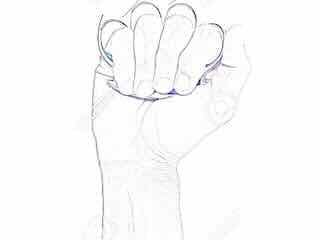



Comments
Post a Comment