Arecent story about a bank in Dubai in the seventies brought back a memory of my time with Peter Rawlings — those days when even the smallest task seemed to carry a curious weight, especially under his watchful, forward-leaning gaze.
Dubai in the seventies was not the city people know today. There were no glass towers competing with the sky, no vast highways humming with restless traffic. The city was still discovering itself — half trading post, half promise. The creek was its lifeline, and along it stood a handful of buildings that seemed, at the time, important enough to hold the future together. Our bank was one of them.
Inside, the world was smaller, slower, and yet, in its own way, intensely serious.
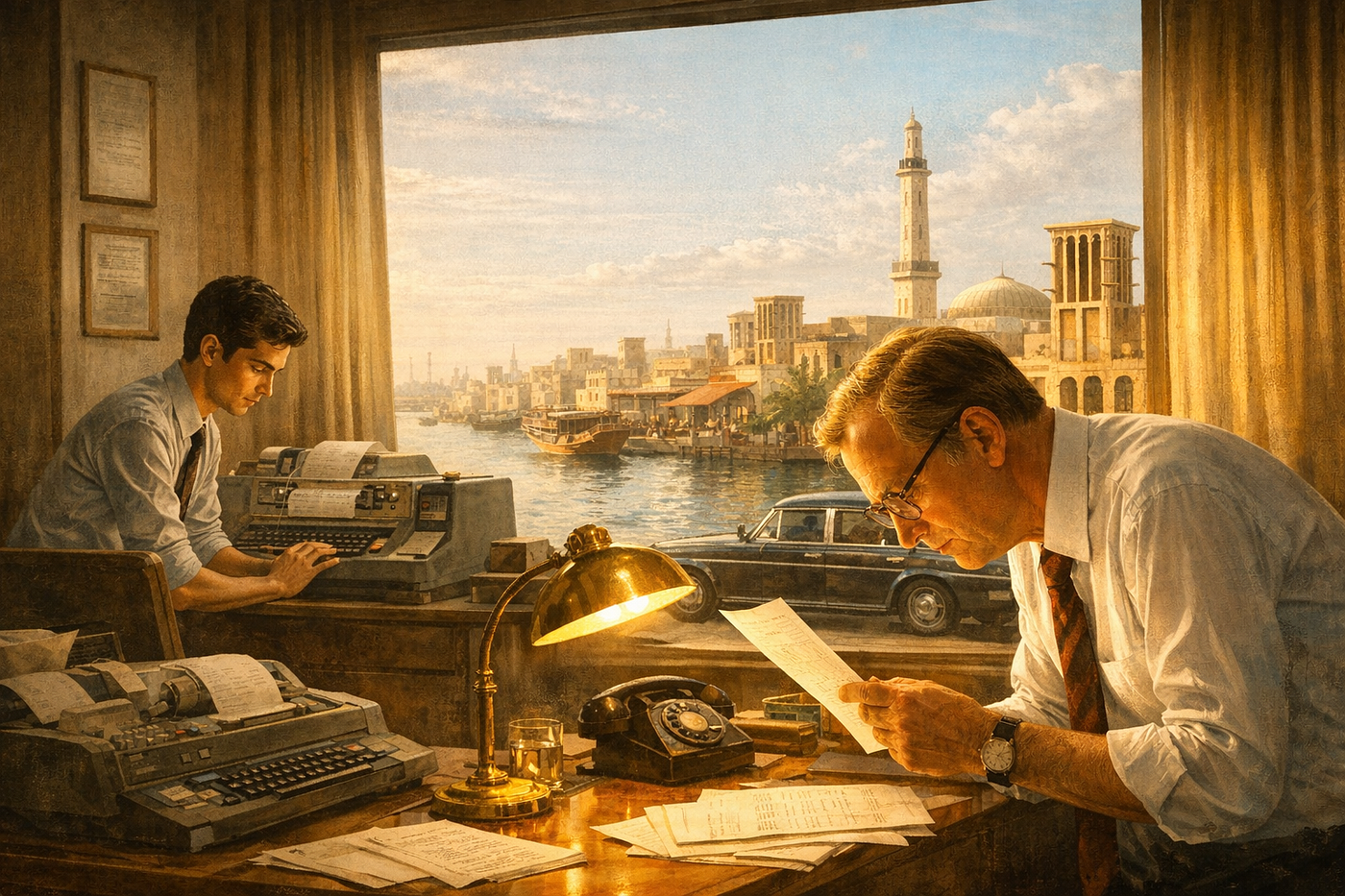
Peter Rawlings was the manager — spectacles firmly in place and a permanent forward bend, as though he were always about to catch a thought before it escaped. One had the impression that even if nothing required his attention, Peter would invent something, just to keep the machinery of order turning.
He read loan applications the way a strict schoolmaster reads examination papers — not merely for the answers, but for the commas, the spelling, and the general moral character of the writer. A misplaced apostrophe could, I suspect, delay a loan by at least a day. This was not fussiness — it was London.
Because every approved document did not simply stay in Dubai. It travelled — by telex — to the head office at King William Street. For those unfamiliar, the telex was the bloodstream of global banking then: messages tapped out on clattering machines, carried across continents in coded form, arriving in distant offices with a kind of mechanical certainty.
And so, each message had to be coded. Names dissolved into sequences, stripped of identity, as though we were running a discreet intelligence service rather than a bank. There was a quiet drama to it — ordinary loans dressed up in secrecy, travelling from a sunlit creek in Dubai to a damp street in London.
Mark Harrison and I, of course, found great amusement in this. What began as careful, disciplined coding soon turned into a private competition. Before long, I could code outgoing messages and decipher incoming ones at a speed that gave me immense satisfaction — and occasionally caused Peter to look at me with mild suspicion.
Press enter or click to view image in full size
Peter himself carried the air of a man entirely certain that things would turn out well — and, annoyingly enough, they usually did. His title then was simply “Manager.” Today, it would likely be something grander — CEO, perhaps — which somehow suits him. But in my mind, he remains fixed in that earlier time: at the top of the stairs, leaning forward, holding a document up to the light as if it might confess something under scrutiny.
Then there was Geraldine Costa — “Duchy,” as we called her — long before the world upgraded such roles to “Executive Assistant.” Duchy ran the outer office with a quiet authority that required no announcement. She allowed no nonsense, tolerated no disorder, and maintained a sense of calm that felt almost miraculous given the rest of us.
Next door sat Suresh Rai, the commercial manager, who, like many in those days, seemed connected to someone else in the building. These relationships ran through the bank like invisible threads — pull one, and another would reveal itself. In a city still small enough to remember names, such connections mattered.
And then there was Noor. Officially a peon — or farash — but in truth, a man of quiet importance. Noor opened doors, appeared with tea at exactly the right moment, and carried the manager’s briefcase with a dignity that suggested he understood more than he ever let on.
Outside, the manager’s car — Cadillac or Mercedes, depending on the day — waited like part of a carefully arranged scene. These details mattered. They signalled order, hierarchy, and a certain idea of success. Rashid, the driver, carried himself with easy confidence and, as I recall, had a fine talent for cricket. Even this role had its own standing, its own unspoken privileges.
Looking back now, it all feels faintly theatrical — a small, self-contained world where roles were clearly defined, rituals quietly observed, and ambitions just beginning to stretch beyond the horizon.
Dubai would go on to become something vast and astonishing. But in those days, it was still intimate enough for a young man to believe that coding a telex message, correctly and quickly, was not just work — but a small act of importance in a much larger story.
Packing lists An addiction to packing lists Denzil Jayasinghe 3 min read·Nov 6, 2022 My fascination with packing lists started when I was young. Eventually, it became a life-long habit, a kind of addiction. When I enrolled at the Christian brothers’ formative school at eleven, a packing list was given to my parents. 2 School shorts 2 School shirts, white 2 Baniyans, aka vests 4 Pairs of white socks 1 Sarong 2 Casual shirts 2 Casual shorts 2 Handkerchiefs 1 Toothbrush 1 Comb 1 Bedsheet 2 Pillowcases 1 Pair of black shoes 1 Pair of canvas sports shoes My parents went into fast gear to assemble the packing list. My father started from the bottom of the list, the shoes. He took me by bus to Colombo to P G Martins, a shoemaker. We came out of that shoe store with DS-branded black and Shinwa-branded canvas shoes. Also bought was a Ford suitcase, in shiny sky-blue colour. Mother bought vests and socks from Velona, a garment outlet run by one of our relations, Aunty Helen. A trip to a ta...
A Child of Curiosity How inherent inquisitiveness became a key driver in learning experiences. Denzil Jayasinghe · B orn in the mid-20th century, I am a product of the post-World War II era. My parents, who were teenagers when the war commenced, married in the 1950s. As a representative of the baby boomer generation, I was born under the astrological sign of Capricorn, the tenth sign of the zodiac. My birth took place at Zoysa Nursing Home, a renowned institution in Colombo, Sri Lanka, around 5 in the morning. Sri Lanka, known for its tropical climate, is a beautiful island nation south of India. This climate appealed to me, and I sought similar weather in my twenties, spending them in Dubai, where the winter resembles an Australian summer. Raised by religious parents, I held them in deep affection. However, the church teachings posed a paradox for a young mind, instructing one to love God more than one’s parents. I initially adhered to the Ten Commandments and other societal norms in ...
Doctor Doctor Memories of medical care in my early years As a toddler, I contracted whooping cough, a deadly disease of that time. My mother went through a lot of anxiety until I got better. She was so pleased with the doctor who treated me that he became our family doctor. As a two-year-old, I don’t remember a thing about that trying time. It must have shaken my mother so much; she thought my survival was a miracle. She never failed to remind me of that fact growing up. At four years, I was operated on for hydrocele at Lady Ridgeway Children’s Hospital in Colombo. During my entire stay, my mother stayed with me at the hospital, sleeping nearby. I have great memories in the hospital, caring nurses and frequent visits from my grandfather, Lewis . I loved his visits, his fancy stories sitting on my bed. When the hospital discharged me after four days, my grandfather carried me to his car. Back home, I was not allowed to wear pants until I healed. That was embarrassing. The discharge...


Comments
Post a Comment