Iturned sixteen that year, in the kind of heat that made the whole village move slower, and I was looking for something I couldn’t have named at the time. Not a girl, not yet. Something closer to just wanting to see myself plainly, without anyone’s eyes on me but my own.
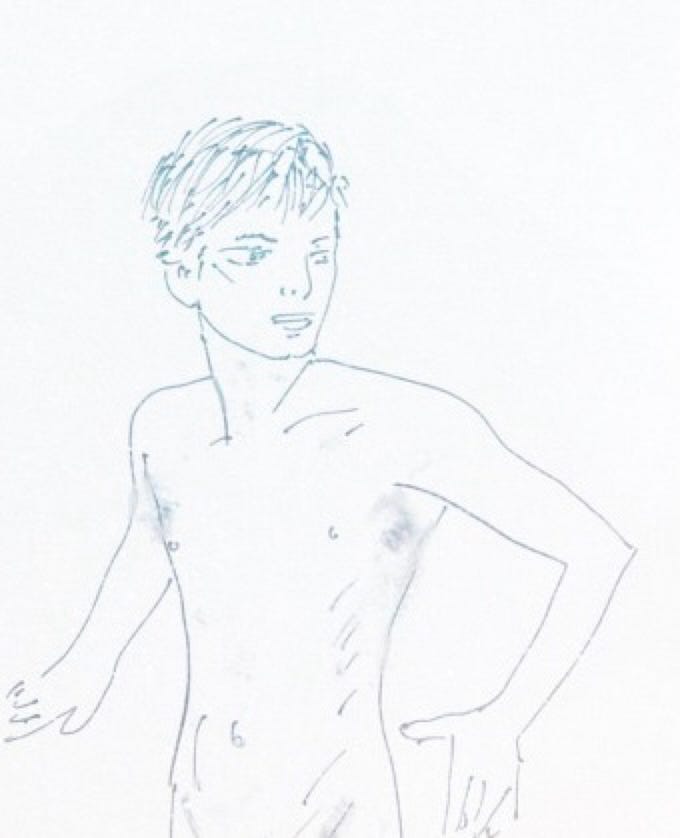
My mother’s dressing table had a long mirror, the kind that showed you the whole of yourself instead of just the face you gave the world. I stood in front of it one afternoon with a pencil and a few sheets of paper, and I drew what I saw. Not well. Not with any training or theory behind it – I didn’t know what an artist’s studio was, had never heard the word “model,” had no idea life drawing was a discipline other people took seriously. I removed my short pants with elastic waist band stitched by my mother. I only knew I wanted to put myself down on paper, exactly as I was, and see if the two versions matched.
Looking back now it has the shape of something bohemian, even artistic, but at the time it was just a sixteen-year-old alone in a room, drawing badly, trying to work out who he was going to be.
That came before the real reckoning, which didn’t arrive until eighteen or nineteen.
I lived two lives in those years, the way a lot of boys in Dalugama did without quite admitting it. Mornings I put on a white shirt and pants and took the bus into Colombo, to a school with ivy on the walls and boys whose fathers had cars. In the afternoons I came home to a village where the roads weren’t paved past a certain point and the neighbours’ sons went to schools with no ivy at all, no cars waiting outside, no expectation that any of it would lead anywhere in particular.
Nobody told me to keep these two worlds separate. I did it myself, without thinking, the way you learn to speak differently to your grandmother than to your friends. Colombo English in the morning. Village Sinhala by evening. A character folded away before I reached the lane where I actually lived.
I didn’t know yet that this was a thing that would take years to sort out – which self was the real one, or whether that question even had an answer. I only knew that the boy who had stood in front of his mother’s mirror at sixteen, trying to draw himself accurately, hadn’t managed it. You cannot draw what you haven’t decided to be.
The relationships came slowly, and later than they seemed to for the others. I was unsure of myself in a way I didn’t yet have a word for – not shy exactly, more unpractised. Village boys my age had a confidence with girls that came from growing up in and out of each other’s houses their whole lives. I had spent my childhood between two schools and two languages and hadn’t had the same practice.
It took time to lose that unsureness. A carnival here, a conversation there, someone’s sister who talked to you longer than she needed to. Small moments that didn’t feel like anything until years later, when I could see they’d added up to something – a slow accumulation of nerve, the kind you can’t rush and can’t skip.
By the time I was nineteen or twenty I had shaken off enough of the village dust and enough of the Colombo ivy to just be a young man moving through his own life, not entirely sure of himself but no longer standing in front of a mirror asking who he was. I had started, instead, asking who I wanted to be with, and why, and what I had to offer someone else – which is a harder and better question, and one no mirror can answer for you.
That’s the part nobody tells you about coming of age. It isn’t a single afternoon in front of a mirror with a pencil. It’s the years afterward, spent finding out whether the person you drew that day was anyone at all.
Packing lists An addiction to packing lists Denzil Jayasinghe 3 min read·Nov 6, 2022 My fascination with packing lists started when I was young. Eventually, it became a life-long habit, a kind of addiction. When I enrolled at the Christian brothers’ formative school at eleven, a packing list was given to my parents. 2 School shorts 2 School shirts, white 2 Baniyans, aka vests 4 Pairs of white socks 1 Sarong 2 Casual shirts 2 Casual shorts 2 Handkerchiefs 1 Toothbrush 1 Comb 1 Bedsheet 2 Pillowcases 1 Pair of black shoes 1 Pair of canvas sports shoes My parents went into fast gear to assemble the packing list. My father started from the bottom of the list, the shoes. He took me by bus to Colombo to P G Martins, a shoemaker. We came out of that shoe store with DS-branded black and Shinwa-branded canvas shoes. Also bought was a Ford suitcase, in shiny sky-blue colour. Mother bought vests and socks from Velona, a garment outlet run by one of our relations, Aunty Helen. A trip to a ta...
A Child of Curiosity How inherent inquisitiveness became a key driver in learning experiences. Denzil Jayasinghe · B orn in the mid-20th century, I am a product of the post-World War II era. My parents, who were teenagers when the war commenced, married in the 1950s. As a representative of the baby boomer generation, I was born under the astrological sign of Capricorn, the tenth sign of the zodiac. My birth took place at Zoysa Nursing Home, a renowned institution in Colombo, Sri Lanka, around 5 in the morning. Sri Lanka, known for its tropical climate, is a beautiful island nation south of India. This climate appealed to me, and I sought similar weather in my twenties, spending them in Dubai, where the winter resembles an Australian summer. Raised by religious parents, I held them in deep affection. However, the church teachings posed a paradox for a young mind, instructing one to love God more than one’s parents. I initially adhered to the Ten Commandments and other societal norms in ...
Doctor Doctor Memories of medical care in my early years As a toddler, I contracted whooping cough, a deadly disease of that time. My mother went through a lot of anxiety until I got better. She was so pleased with the doctor who treated me that he became our family doctor. As a two-year-old, I don’t remember a thing about that trying time. It must have shaken my mother so much; she thought my survival was a miracle. She never failed to remind me of that fact growing up. At four years, I was operated on for hydrocele at Lady Ridgeway Children’s Hospital in Colombo. During my entire stay, my mother stayed with me at the hospital, sleeping nearby. I have great memories in the hospital, caring nurses and frequent visits from my grandfather, Lewis . I loved his visits, his fancy stories sitting on my bed. When the hospital discharged me after four days, my grandfather carried me to his car. Back home, I was not allowed to wear pants until I healed. That was embarrassing. The discharge...


Comments
Post a Comment